

The allure of Gold Jewelleris as ancient as human civilization itself. For millennia, this luminous, incorruptible metal has captivated the human imagination, serving as a symbol of divine favor, royal authority, and enduring love. From the pharaohs of ancient Egypt to the modern-day metropolises of South Asia, gold has transcended its physical properties to become a cultural cornerstone, an economic pillar, and a deeply personal expression of identity. Within this rich historical tapestry, the role of the jeweler emerges as both an artist and a custodian of legacy. Among the contemporary purveyors of this timeless craft, Gold House Jeweller stands as a testament to the enduring marriage of traditional artistry, uncompromising quality, and the pursuit of perfection.
This comprehensive article embarks on a deeply detailed exploration of the gold jewelry industry, examining the intricate processes of craftsmanship, the complex systems of valuation, the cultural significance of bridal collections, and the evolving trends in precious gems and metals. Through the lens of the standards set by establishments like Gold House Jeweller, we will uncover what it truly takes to transform a raw element mined from the earth into a breathtaking heirloom designed to span generations.
Part I: The Historical and Cultural Tapestry of Gold
The Universal Symbol of Wealth and Divinity
Gold’s physical properties—its malleability, its resistance to tarnish, and its captivating yellow luster—made it uniquely suited for ornamentation early in human history. Unlike other metals that corrode or dull over time, gold remains perpetually radiant. This immutability led early civilizations to associate gold with the sun and the divine. In ancient empires, gold was the exclusive reserve of the gods and their earthly representatives—kings and queens.
As trade routes expanded, gold transitioned from a purely royal prerogative to the ultimate medium of exchange. It funded empires, launched expeditions, and built economies. However, even as it became monetized, its primary cultural function remained ornamental. The crafting of gold jewelry evolved from simple hammered discs to intricate, interwoven masterpieces that required a lifetime of skill to produce.
Gold in the South Asian Context
Nowhere is the cultural significance of gold more pronounced than in South Asia. In countries like Pakistan and India, gold is not merely an accessory; it is woven into the very fabric of society. It represents financial security, social standing, and emotional bonds. The purchase of gold is inextricably linked to major life milestones: the birth of a child, religious festivals, and, most importantly, weddings.
For a South Asian bride, gold jewelry is the centerpiece of her trousseau. It is considered her stridhan—wealth that belongs exclusively to her, providing a financial safety net in times of unforeseen hardship. Beyond its economic value, the bridal jewelry set is a tangible representation of a family’s love, blessings, and ancestral heritage. Establishments like Gold House Jeweller understand this profound cultural weight. When a family walks into a premier jeweler to select pieces for a wedding, they are not engaging in a simple retail transaction; they are participating in a sacred, generational rite of passage.
Part II: Understanding Gold—From the Earth to the Showcase
The Science of Gold Purity: Decoding Karats
Pure gold, as extracted from the earth, is an incredibly soft and pliable metal. In its absolute pure state, it is virtually impossible to craft into durable jewelry, as it would easily bend, scratch, and lose its shape with everyday wear. To achieve the necessary hardness and durability, pure gold must be alloyed—mixed—with other metals such as copper, silver, zinc, or palladium. The proportion of pure gold to these alloyed metals determines the “karat” (K) of the jewelry.
- 24 Karat (24K) Gold: This is pure gold, containing 99.9% gold. It is incredibly soft, highly malleable, and features a distinctively rich, almost orange-yellow hue. While it is the ultimate standard for investment bullion (coins and bars), it is rarely used for intricate jewelry due to its fragility.
- 22 Karat (22K) Gold: Comprising 91.67% pure gold and 8.33% alloyed metals (usually a mix of copper and zinc), 22K is the undisputed king of South Asian jewelry. It strikes the perfect balance, retaining a vibrant, luxurious yellow color while offering enough durability to hold intricate designs, filigree work, and heavy stones. Premium jewelers like Gold House Jeweller heavily feature 22K gold in their traditional and bridal collections.
- 21 Karat (21K) Gold: Containing 87.5% gold, 21K is highly popular in certain Middle Eastern and Asian markets. It is slightly more durable than 22K and is excellent for heavy, everyday wear pieces like bangles and chains.
- 18 Karat (18K) Gold: Made of 75% gold and 25% alloys, 18K gold is the international standard for fine diamond jewelry and high-end watches. The higher percentage of alloys makes it exceptionally strong, providing a secure setting for diamonds and precious gemstones. The alloys can also be manipulated to change the color of the gold—adding more copper creates rose gold, while adding palladium or nickel creates white gold.
- 14 Karat (14K) and Lower: These purities contain 58.3% gold or less. They are highly durable and often used in mass-market fashion jewelry in Western countries, but are generally not favored by traditional jewelers focused on heirloom quality.
Hallmarking and Certification: The Pillars of Trust
The most critical element in the relationship between a jeweler and a client is trust. Because the naked eye cannot accurately determine the exact karatage of a piece of gold, the industry relies on rigorous certification and hallmarking systems.
A hallmark is an official mark or series of marks struck on items made of precious metals to certify the metallurgical content. When you purchase a piece from a reputable source like Gold House Jeweller, it should carry specific markings that indicate its purity (such as “916” for 22K gold, representing 91.6% purity), the jeweler’s identification mark, and potentially a recognized assay office stamp.
Transparency in weighing is equally vital. The weight of the gold must be calculated separately from any stones, enamel, or non-gold materials included in the piece. Leading jewelers utilize highly calibrated, digital scales that are visible to the customer, ensuring absolute clarity in the transaction. This commitment to honesty is what elevates a jewelry store from a mere vendor to a trusted family advisor.
Part III: The Master Craftsmanship Behind the Masterpieces
The transformation of a gold ingot into a breathtaking piece of jewelry is a labor-intensive process that requires the steady hands, keen eyes, and immense patience of master artisans, often referred to as karigars. The techniques used by these craftsmen have been passed down through generations, often guarded as fierce family secrets.
Traditional Techniques That Define Excellence
1. Kundan Setting: Kundan is one of the oldest forms of jewelry making in South Asia, originating in the royal courts of Rajasthan and Gujarat. The process involves setting precious stones (traditionally uncut diamonds known as Polki) into a gold foil bed. The karigar meticulously shapes a delicate framework of 24K pure gold foil around the stone, pressing and burnishing it until it forms a secure, seamless bezel. The reverse side of Kundan jewelry is often as beautifully decorated as the front, usually adorned with vivid Meenakari enamel work.
2. Meenakari (Enameling): Meenakari is the art of coloring and ornamenting the surface of metals by fusing brilliant colors over it in an intricate design. Grooves or depressions are carved into the gold surface, which are then filled with colored glass powder (enamel). The piece is fired in a kiln, causing the powder to melt and fuse with the metal. The result is a vibrant, intricate pattern of reds, greens, blues, and whites that contrasts stunningly with the yellow gold.
3. Filigree and Granulation: Filigree involves taking fine, pliable threads of gold and twisting, curling, and soldering them together to create delicate, lace-like patterns. It is painstaking work that requires a jeweler to manipulate wires thinner than a human hair. Granulation is a related technique where tiny spheres of gold are individually fused to a surface to create texture and pattern. Together, these techniques create jewelry that looks incredibly voluminous and ornate but is surprisingly lightweight.
4. Casting and Die-Stamping: While traditional handcrafted techniques remain the pinnacle of luxury, modern jewelers also employ advanced methods like lost-wax casting. A design is carved into wax, encased in plaster, and heated so the wax melts away, leaving a negative mold. Molten gold is then poured into the mold. This allows for the creation of identical, highly detailed components, ensuring consistency and precision.
The Gold House Jeweller Approach
A premier establishment like Gold House Jeweller distinguishes itself by offering a curated blend of these techniques. While they may utilize modern Computer-Aided Design (CAD) and 3D printing to prototype complex modern pieces with mathematical precision, the final execution, setting of stones, and polishing are invariably done by the hands of master karigars. This synthesis of modern technology and ancient artisanship ensures that every piece is structurally flawless yet retains the “soul” of a handcrafted heirloom.
Part IV: The Anatomy of the Ultimate Bridal Collection
For jewelers, the bridal collection is the ultimate showcase of their design philosophy, technical prowess, and understanding of cultural aesthetics. A complete traditional South Asian bridal set is a complex ensemble of interconnected pieces, designed to adorn the bride from head to toe.
The Core Elements of a Bridal Set
1. The Neckpieces (Choker and Rani Haar): The neckpiece is the focal point of the bridal ensemble. Traditionally, brides wear multiple layers. The foundation is often a heavily crafted Choker that sits snugly against the neck, drawing attention to the face. Below the choker lies the Rani Haar (The Queen’s Necklace), a long, regal, multi-layered necklace that cascades down the chest. A masterful jeweler ensures that the motifs, stonework, and gold finish of the choker and the Rani Haar complement each other perfectly, without looking cluttered.
2. Head Ornaments (Maatha Patti, Tikka, and Jhumar): The forehead is adorned with a Tikka, a pendant suspended from the hairline. A more elaborate version is the Maatha Patti, which includes jeweled bands that trace the hairline along both sides of the face. The Jhumar or Passa is an asymmetrical, fan-shaped ornament worn on the left side of the head, adding a distinctively royal, Mughal aesthetic to the bride’s profile.
3. The Nath (Nose Ring): The Nath is perhaps the most culturally significant piece of bridal jewelry, symbolizing marital status. Ranging from small, delicate hoops with a single pearl to massive, elaborate rings supported by a jeweled chain pinned to the hair, the Nath dramatically transforms the bride’s face.
4. Earrings (Jhumkas, Chaandbaalis, or Sahare): Bridal earrings are typically large and heavy. Jhumkas (bell-shaped earrings) and Chaandbaalis (crescent moon-shaped earrings) are perpetual favorites. Because these earrings can be incredibly heavy, jewelers often design them with Sahare—jeweled chains that hook over the ear or pin into the hair to support the weight and prevent the earlobes from stretching.
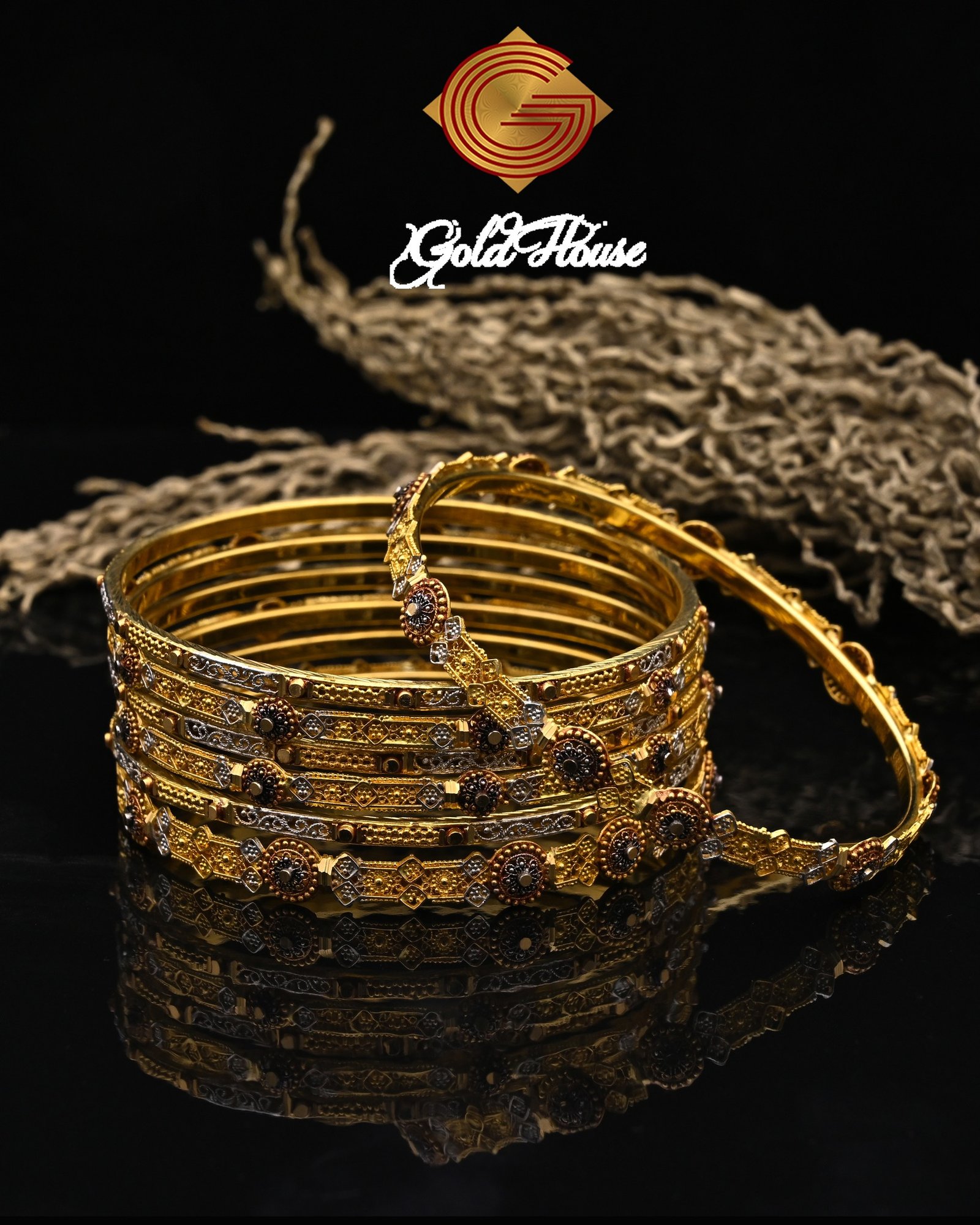
5. Hand Ornaments (Bangles, Chooda, and Haath Phool): A bride’s arms are adorned with an array of bangles, kadas (thick bangles), and bracelets. The Haath Phool (Flower of the Hand) is a stunning piece consisting of rings connected by delicate gold chains to a central medallion on the back of the hand, which further connects to a bracelet around the wrist.
Customization and The Bespoke Experience
Selecting bridal jewelry is rarely an off-the-shelf process. High-end boutiques like Gold House Jeweller offer bespoke services where clients can sit down with designers to create custom sets. This involves analyzing the bride’s facial structure, the neckline of her bridal outfit, the color palette of her dress, and her personal style preferences. Whether a bride desires a heavily enameled, antique-finish Kundan set or a sleek, contemporary diamond-and-white-gold ensemble, the jeweler acts as a creative partner, bringing her vision to life.
Part V: Beyond Gold—The Integration of Diamonds and Precious Stones
While gold is the foundation, it is the integration of precious stones that elevates jewelry to the realm of high art. The interplay between the warm glow of gold and the brilliant fire of a diamond creates a visual synergy that has captivated humanity for centuries.
The Fascination with Diamonds
Diamonds are the hardest naturally occurring substance on earth, formed deep within the earth’s mantle under immense heat and pressure over billions of years. When cut and polished by a master lapidary, a diamond’s ability to refract and reflect light is unmatched.
When dealing in diamonds, premium jewelers adhere strictly to the 4Cs, developed by the Gemological Institute of America (GIA):
- Carat: The weight of the diamond. Larger diamonds are exponentially rarer and thus more valuable.
- Color: Counterintuitively, the best color for a standard diamond is the absolute lack of color. Graded on a scale from D (colorless) to Z (light yellow/brown), high-end jewelers typically deal in the D-H range for their premium collections.
- Clarity: This measures the presence of internal inclusions and external blemishes. A “Flawless” diamond is exceedingly rare. Most jewelry uses diamonds in the VVS (Very Very Slightly Included) to SI (Slightly Included) range, where flaws are invisible to the naked eye.
- Cut: This is the only “C” influenced by human hands, and it is arguably the most important. The cut determines how well the diamond interacts with light. A perfectly cut diamond will exhibit maximum brightness, fire (flashes of color), and scintillation (sparkle).
Setting the Stones
The method used to secure a stone into the gold—the setting—dramatically affects the look of the piece.
- Prong Setting: Uses small metal claws to grip the diamond, allowing maximum light to enter the stone.
- Bezel Setting: A thin strip of metal completely encircles the stone, offering excellent protection.
- Pavé Setting: Tiny diamonds are set closely together, separated only by minute beads of gold, creating a surface that appears to be entirely paved with diamonds.
- Channel Setting: Stones are suspended between two parallel walls of gold, popular in wedding bands and tennis bracelets.
The Allure of Colored Gemstones
Beyond diamonds, jewelers utilize the “Big Three” precious colored stones:
- Rubies: With their deep, passionate red color, rubies look exceptionally striking when set in 22K yellow gold. They are a symbol of vitality and royalty.
- Emeralds: The lush green of an emerald pairs beautifully with both yellow gold and diamonds. However, emeralds are naturally more brittle than other stones and require a highly skilled karigar to set them without chipping.
- Sapphires: While blue is the most famous hue, sapphires come in almost every color except red. They are incredibly durable, making them ideal for everyday wear rings.
An elite establishment like Gold House Jeweller often imports high-quality, certified diamonds and precious stones, offering clients the opportunity to select loose stones and have them custom-set into bespoke gold mountings, ensuring total control over the quality of the final product.
Part VI: Gold as a Financial Asset and Investment
While the aesthetic and emotional value of gold jewelry is immeasurable, its role as a financial asset cannot be ignored. Gold has been a reliable store of value throughout economic crises, inflation, and geopolitical instability.
The Economics of Jewelry Investment
Purchasing gold jewelry is unique because it is one of the few investments that provides immense utility and enjoyment while it appreciates in value. However, it is essential to understand the financial mechanics of buying jewelry:
- The Base Price (Gold Rate): The cost of the raw gold, determined by the international spot price of gold, which fluctuates daily based on global market conditions.
- Making Charges: This is the cost of the labor, design, and craftsmanship. Complex pieces like intricate filigree or Kundan work have higher making charges than simple chains or cast bangles. Making charges can range from 8% to 25% or more of the gold value.
- Wastage: During the handcrafting process, small amounts of gold are inevitably lost as dust during filing and polishing. Jewelers often factor a standard wastage percentage into the final price.
- Value of Stones: Stones are priced separately from the gold.
Liquidity and Exchange
When returning or upgrading gold jewelry, the policies of the jeweler matter immensely. Reputable jewelers like Gold House Jeweller typically have transparent buy-back and exchange policies. Usually, when exchanging an old piece for a new one, a trusted jeweler will value the gold content at the current daily rate, deducting only the original making charges and any minor melting losses. This allows families to continually update their collections over generations without losing the principal value of the gold.
It is crucial to note that while 22K jewelry is excellent for wealth preservation, stones and diamonds may not offer the same rapid liquidity or guaranteed appreciation as the gold itself. Therefore, pure gold pieces (like heavy bangles or chains) are often favored by those looking strictly at the investment angle.
Part VII: The Ultimate Customer Experience—Walking into a Master Jeweller
The experience of buying fine jewelry should be as luxurious and memorable as the jewelry itself. When a client walks into a premier boutique like Gold House Jeweller, they are stepping into an environment designed to provide comfort, security, and inspiration.
The Ambiance
High-end jewelry stores are meticulously designed. The lighting is precisely calibrated to showcase the brilliance of the gold and the fire of the diamonds without being harsh. The atmosphere is generally calm and quiet, allowing for focused, unhurried decision-making. Security is, of course, paramount, but it is typically integrated seamlessly so as not to detract from the luxury experience.
The Consultation
The staff at a premier jeweler are not mere salespeople; they are consultants and gemologists. A good consultant will take the time to understand the client’s needs. Are they looking for an everyday office wear piece, a gift for a graduation, or a heavy bridal set? They will ask about budget parameters and stylistic preferences, guiding the client through various trays of inventory, explaining the subtle differences in craftsmanship, stone quality, and gold purity.
After-Sales Service and Lifetime Care
The relationship with a jeweler does not end when the receipt is printed. Fine jewelry requires maintenance. Over time, gold can pick up micro-scratches that dull its finish, and the prongs holding precious stones can loosen due to daily wear and tear.
A hallmark of a top-tier establishment is its commitment to after-sales care. This includes:
- Professional Cleaning: Using ultrasonic cleaners and specialized solutions to remove dirt and oils that accumulate behind stones and in the crevices of intricate designs.
- Polishing: Re-buffing the gold surface to restore its original, mirror-like shine.
- Rhodium Plating: For white gold jewelry, which naturally fades to a slight yellowish tint over time, re-applying a thin layer of rhodium restores its bright white finish.
- Prong Tightening: Routinely checking the settings of diamonds and gemstones under a loupe to ensure no stones are at risk of falling out.
- Repairs: Expertly soldering broken chains or resizing rings as the wearer’s fingers change over time.
Part VIII: The Future of Gold Jewelry—Trends and Innovations
The gold jewelry industry, while deeply rooted in tradition, is not static. It continuously evolves to meet the changing tastes of new generations and the shifting realities of the global market.
Shifting Aesthetic Paradigms
While the demand for heavy, traditional bridal wear remains robust in South Asia, daily wear trends have shifted significantly. The modern consumer often gravitates toward minimalism. Delicate chains, stackable geometric rings, and subtle diamond studs have become immensely popular. There is a growing desire for versatile pieces that can transition seamlessly from professional environments to evening social events.
Conversely, there is also a rising trend of fusion jewelry—combining Western silhouettes with traditional Indian or Pakistani motifs. For instance, a modern, asymmetrical cocktail ring might feature ancient Meenakari enameling, or a sleek white gold collar necklace might be set with uncut Polki diamonds.
Ethical Sourcing and Sustainability
The modern consumer is increasingly conscious of the origins of their purchases. There is a growing demand for “conflict-free” diamonds and ethically mined gold. The jewelry industry is responding with greater transparency in supply chains, ensuring that the mining processes respect human rights and minimize environmental impact. Premier jewelers are increasingly adopting strict sourcing policies to assure their clients that their beautiful investments are also ethically sound.
Part IX: A Guide to Caring for Your Gold Treasures at Home
While professional maintenance by your trusted jeweler is essential, proper daily care at home is crucial for preserving the longevity and luster of your gold pieces.
- Keep it Away from Chemicals: Gold is highly susceptible to discoloration from harsh chemicals. Chlorine, found in swimming pools and household bleach, is particularly damaging and can actually weaken the structure of gold alloys over time, causing prongs to snap. Always remove jewelry before swimming or cleaning.
- Beware of Cosmetics: Hairspray, perfume, and lotions contain chemicals and oils that can leave a dulling film on gold and stones. The golden rule is: Jewelry should be the last thing you put on before leaving the house and the first thing you take off when you return.
- Safe Storage: Gold is a relatively soft metal and can easily be scratched by harder gemstones (like diamonds) or even by other gold pieces. Jewelry should be stored in individual, fabric-lined compartments or soft cloth pouches. Never toss your jewelry into a single, jumbled box.
- Gentle Home Cleaning: For routine cleaning, soak your gold jewelry in a bowl of warm water mixed with a few drops of mild dish soap. Let it sit for 10-15 minutes to loosen any dirt. Gently scrub with a very soft-bristled toothbrush (a baby toothbrush is ideal), paying special attention to the backs of stones where lotions accumulate. Rinse thoroughly under warm running water and pat dry with a soft, lint-free cloth.
- Avoid Extreme Temperatures: Sudden temperature changes can affect the integrity of certain colored gemstones set in gold, potentially causing them to crack.
Conclusion: The Enduring Legacy
In a world characterized by rapid change and fleeting trends, gold jewelry remains a steadfast anchor of value, culture, and artistry. It is a unique medium that captures the brilliance of the earth, the genius of human craftsmanship, and the profound emotions of the wearer.
Establishments that master this trade, such as Gold House Jeweller, serve as vital custodians of this ancient art. By refusing to compromise on the purity of their metals, by championing the painstaking skills of their karigars, and by honoring the profound trust placed in them by their clients, they do more than just sell ornaments. They help weave the physical manifestations of family legacies.